Monday, January 23, 2012

Which Boat Gives The Most Satisfaction?

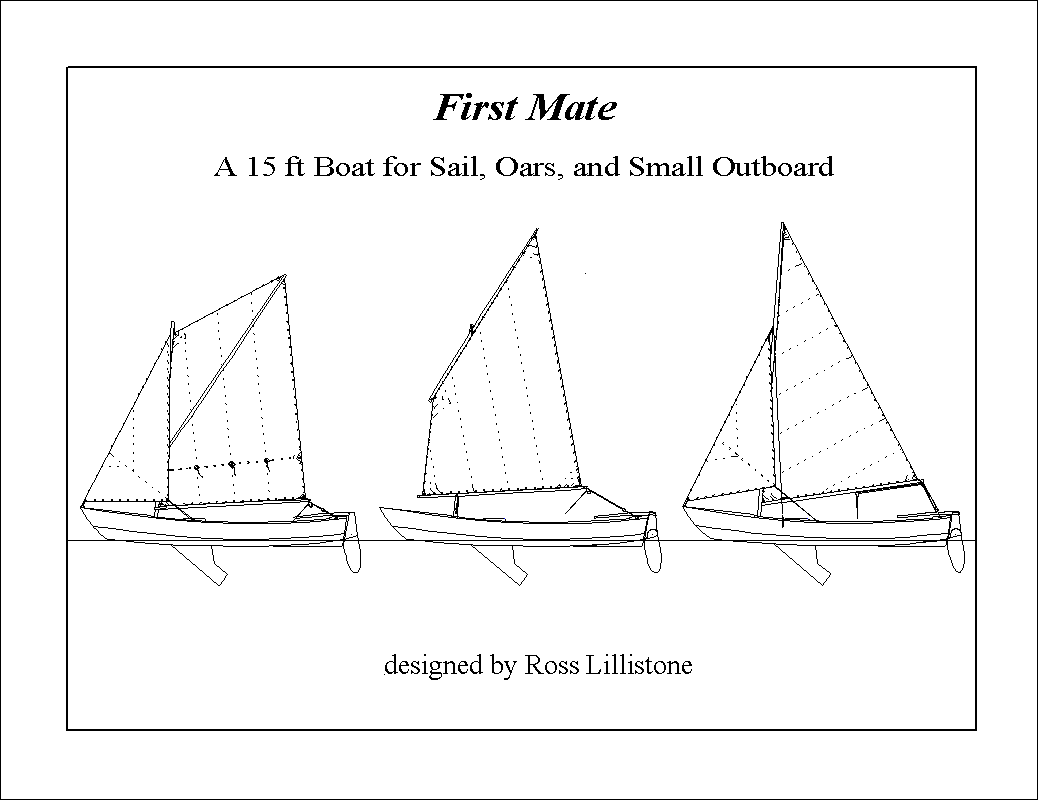
This a re-print of a short article I wrote about 3-1/2 years ago. I still think it is worth a read. For those who are interested, the boats in the article are my First Mate design, and Phil Bolger's 30ft Romp.

In the late afternoon of a balmy North Queensland day, a man in his fifties sat in a small rowing and sailing dinghy, near the banks of a sandy estuary. It was not the great physical beauty of the mangrove-fringed inlet that was the object of his attention, but a clean-lined sailing cruiser of about thirty feet length-overall which sat quietly at anchor only a short distance from the sand.

As is always the case for those obsessed with boats, the man was constantly alert for the sight of something different from the normal run of fibreglass, stainless steel, and push-pit barbeques; and this particular vessel had caught his eye from a long way off. What was different about her? Well, she was free from the normal clutter of standing rigging, furled headsails, high cabin trunks and inflatables, and importantly, she was anchored in what appeared to be impossibly shallow water for a boat of her size. Above all, there was something about her character that struck him as familiar.


August and September are wonderful months way up north in the tropics, and rowing around an isolated estuary is good for the soul at a time when the sun is low – as long as you have your eyes open for crocodiles! This fellow had rowed and sailed in the particular location hundreds of times over the years, but it never lost its appeal as a sanctuary from his day-to-day work in the nearby city. His boat was a fifteen foot long plywood dinghy, fitted with the most simple of sailing rigs, along with a well-made set of leathered oars and bronze oarlocks.


The interior of the dinghy showed the evidence of frequent use – a collapsible crab pot in the forward space against the centreboard case, a large water container under the thwart, a camera in a waterproof case in a bucket aft and several sorts of other paraphernalia. The internal paintwork had endured its fair share of scratching, and the bundled sail carried grease and mud stains. But the boat was in a good, solid state of repair, and she looked like a capable sort of ship.

The man sat looking at the larger boat for several minutes, resting his hands on the handles of his nicely balanced oars. Then, with a few deft strokes, he spun the sailing dinghy in her own length and sent her in towards the sandy shore beside the object of his attention. As he passed close to the bow of the big cruiser, he noticed that the clear water was only about two feet deep, yet the anchored boat was definitely well afloat. As he continued to paddle along the length of the boat, it became apparent to the oarsman that the boat he was looking at had come from far away. She flew a foreign flag, and his experienced eye could pick the signs of a vessel which had traveled across oceans.

Stepping ashore on the firm sand, our friend dragged the plywood sailing dinghy up until she was safe from drifting, and then he pulled a wooden galley box out from under the main thwart and set a kettle to boil over an old alcohol stove. Had he been in a more exposed location, the man would have moved the boat much further up the beach, using the pair of inflatable rollers which were currently tied up under the side decks. The boat was light enough to be manhandled by him under most circumstances, and he was very grateful that he had resisted the urge to go for a bigger dinghy at the time of construction. To himself he said, “Just like Goldilocks – not too big; not too small; but just right”.

Returning his attention to the larger vessel, he studied her details once again. She had a plumb stem, with a beautifully sharp entry at the waterline, widening out rapidly to a wall-sided midsection which terminated in a shapely stern and a vertical transom of almost triangular cross-section. The overall shape of the boat put him in mind of pictures he had seen of Thames Sailing Barges, although this one did not carry leeboards like the barges. Because the boat did not have any cabin trunk (other than what appeared to be an oversized companionway shelter), the hull sides looked quite high. However, as he waded out to her in the knee-deep water, he discovered that his eyes were almost level with her deck-line, so appearances were deceiving and he could tell that this boat was much lower than the average production boat of her size.

Steam issuing from the kettle called him ashore, and as the man settled down on the sand to drink coffee, he felt the well-known demon of “Unreasonable Boat Desire” creeping up on him once again. This thirty-footer struck him as just about the ideal escape machine with her free-standing cat-yawl rig, one-and-a-half foot draft, centreboard and clean deck-line. That she was an ocean-going craft was beyond doubt, and he could see that in comparison with the average sailing boat tied up in a marina, she would be very cheap to build and maintain. In his mind’s eye he could see himself cruising the Great Barrier Reef, sailing to New Caledonia, reeling in large fish, weathering tropical storms without the slightest concern, and living out childhood fantasies related to desert islands and buried treasure. Oh no, it was all happening again…!

Now this fellow had a close friend who was known for his conservative (some would say, “boring”) views, and as he sat dreaming about the feats he could achieve in this wonderful ocean-cruiser, he could hear his friend’s voice-of-reason sounding in the back of his head. “Don’t do it,” the voice said, “you know the boat is too big.” He shook his head, but the phantom voice continued, “You know that a big boat will drain your financial and physical resources, and that you will get far more use out of your superb little sailing dinghy.” Still the voice droned on, “You can only just manage to keep the paint up to your little boat, you lazy so-and-so; how do you expect to maintain a thirty-footer?”

Turning to the right, the middle-aged mariner looked at his existing boat. She was light, and very good-looking. The rig was strong, simple, free-standing and easy to repair. As she sat on the sand he could see with great satisfaction that the lowered sailing rig lay nicely in a compact bundle to one side, well clear of his rowing position. Many times he had slept on-board, having set off after work to row or sail for a few hours before bedding down for the night on the sleeping platform he had fashioned inside the dinghy. With the boom tent rigged, he was well protected from insects and light rain, and the snug interior made him feel secure. After use, the boat could be tucked away in a corner of his shed until needed for the next mild adventure. Annual maintenance was minimal.


The afternoon sea-breeze being favourable, the sailor set the small boat’s rig (three minute’s work) and ran out of the inlet for an hour or so of sailing in the tropical evening, knowing that for him at least, the freedom provided by the small plywood dinghy was beyond price. He had built her with his own hands, and the cost had been tiny. The returns, however, had been enormous.


Sunday, January 15, 2012

Wildlife at the Boatshop

I'm starting the year's posts with a slightly off-subject entry. It is now six years since we moved away from our coastal workshop to live and work in Esk, Queensland, Australia. Although we only moved 100 kilometres (62 miles), the move was directly to the west - away from the coast. Many people thought we were mad, but we needed to locate ourselves in a quieter place, further away from the scores of casual visitors who had been in the shop at all hours. I like talking to people about boats, and I particularly enjoy explaining building procedures, and therein lay the problem. I was spending long hours in the shop, but not getting enough paying work done!

The old workshop in Wynnum. The office is under the sign at the far left, and workshop area extends to beyond the far right of the photo - it was a paradise!

Looking through the building from just outside the office. Notice the wooden floor and low ceiling - perfect for boatbuilding.
Well, moving into a rural area where horse-floats and cattle trucks outnumber the boats 500 to 1 may seem like a dumb thing to do, but we had our reasons (mostly financial). As it has turned out, we are very happy and enjoy the quiet surroundings. There is a 35 kilometre-long lake just down the road, and if we want to get to salt water it is only an hour-and-a-half by the highway.

The Esk workshop. Since this photo was taken there have been improvements, such as a concrete slab under the lean-to, but it is still basically 9metres x 10.5 metres (29ft x 34ft) of concrete under tin sheds, and a separate 6 metre x 6 metre storage shed. However, I work alone most of the time, assisted by my wonderful wife when things get tough, so I am pretty happy with what I have.
Inside one of the workshops
Being in the bush has its inconveniences, but the advantages outweigh the negatives many times over for a hermit like me. One of the significant benefits is that we get to observe native wildlife at close range, and come to take it all for granted.

Possum in a model aircraft
My wife with a totally wild Rainbow Lorikeet
Same fellow up close after eating apple
A King Parrot - once again, totally wild
A Koala ten paces from the workshop door
A buck Wallaby making friends with our cat through the front door glass!

For those of you who may be interested in Australian wildlife, here is a youtube video which I shot over the last couple of days. The quality is not high, as I didn't have a tripod, and there was too much backlight in some frames - but if you have never seen a Wallaby Joey in its mother's pouch, or seen a Koala climb a tree, take a look. All shots were taken within five yards of our door!


These photos may not show you how to build a boat, but I can assure you that the presence of these animals helps me to retain some perspective on what is important in life, and I'm sure that my building and designing benefits as a result.....

Friday, December 30, 2011

Periwinkle Video


Periwinkle was designed and built by me for her owner, John Shrapnel. She is a long, lean boat with very fine sections up for'ard to help her get through a head sea relatively easily, and without making her crew too wet. Towards the end of the video you can see how the fine entry allows the water to peel off the side of the boat rather than flying into the air to be blown over the occupants. The plank laps associated with the glued-lapstrake (clinker) construction also help tremendously in knocking the water down.

Although she is 17ft long, Periwinkle is actually a smaller boat than she looks, and she needs to be trimmed properly to get the best from her - she doesn't like weight in the bow, but all boats are compromises, and in this case the advantages described in the first paragraph make up for the attention needed regarding trim. In the video, John Shrapnel has her longitudinal trim perfect, sitting on the wide and comfortable seat just forward of the expansive aft deck and buoyancy compartment.

Large aft compartment and buoyancy/storage compartment

Room for sleeping, and note how the aft deck hatch is on the centreline, so even if the lid is open, water will not flood in during a capsise
The following video was shot on the east coast of Australia, at Caloundra, Queensland.


You can see more information about Periwinkle on my website here and here and here

Thursday, December 22, 2011

Whimbrel Yet Again - Two Comments


Robert has followed-up on the previous couple of comments: -
Ross, since you see the utility inherent in the slot-top option and go so far as to state you would thus modify Whimbrel for your own use, would it be feasible to offer an additional sheet in the plans to make this an option?

Then there is that magic number I was waiting to see... the hull weight. I know more than one person is eyeing Whimbrel as a possible Everglades Challenge option. I do hope the actual number is "significantly reduced" as you believe. The Core Sound 20 finishes out at between 500 and 600 pounds sans gear, no cabin of course. Time will tell...

Well, I have to admit that I haven't done a full "weights and moments" calculation on Whimbrel. What I did in the previous post (with full disclosure at the time) was to take the total volume of plywood in the boat, multiply the volume by 600 to determine the weight of the ply in kilograms, and then I simply doubled it to account for timber components, glass, epoxy, fasteners, rig etc. This is totally unscientific, but I believed it to be conservative. What is more the selection of 600 kg/cu.m was also conservative, as we are able to obtain good quality marine plywood here which has an actual density of 420 kg/cu.m. The reason that I used 600 kg/cu.m as the figure was to account for the variability in the actual weight density of plywood supplied by the retailers. There is a retailer in this country selling BS1088 plywood which is advertised as being 430kg/cu.m - but when tests were conducted locally on actual samples, the density proved to be around 600 kg/cu.m!!!
If one was sure of having 420kg/cu.m ply, and even using the conservative doubling system that I described, the weight of the boat (including decks and cabin) could be as low as 220kg/484lbs.
I'm sure that the Core Sound 20 is an excellent boat, but she is a different vessel from Whimbrel. Firstly, Whimbrel has a full cabin, lots of built-in compartments, a self-draining cockpit, and a tabernacle. In addition, I designed Whimbrel to comply with the scantlings rules as laid down by Dave Gerr N.A. who is currently the Principal of Westlawn. as far as I can make out from my own study and from discussions I've had with a well credentialed Westlawn graduate, Dave Gerr's scanting rules are conservative in comparison with ABS standards - in other words, if you build to Dave's rules, the boat will be stronger and slightly heavier than required. I am very happy with that!
One of the things I had in mind when I drew Whimbrel was that I wanted a solid little ship which would last a lifetime. As you are probably aware, I hold the work of Phil Bolger in very high regard, but I was mildly concerned to discover that a Micro built to specification was somewhat flimsy. For example, you can push the side panels in and out, and when walking around on the cabin top it is necessary to place feet near frames, bulkheads or other supported areas, because the 6mm/1/4" plywood (from which the entire hull is made) flexes alarmingly.

Whimbrel has 12mm/1/2" panels on the bottom, 9mm/3/8" ply on the topsides, 12mm/1/2" on the cockpit floor, cockpit seats and cabin sole, and the cabin top is made of 6mm/1/4" on 50mm x 20mm (2" x 3/4") longitudinal stringers on 200mm spacings or less. This is a rugged "tugboat-tough" boat and not a light-weight daysailer.

Yes, I will do a sheet covering the simple option of a "slot-top". One could easily stand against the forward end of the cabin and reach down into the anchor locker and deck hatch.

Rick Hayhoe has written back: -

<> <><>
I went back over images I have and could access of scows among American watercraft, where they were used in the Gulf of Mexico fishery and for transport of timber, coal and other bulk cargo along the US west coast. I find, contrary to the opinion I expressed earlier regarding Whimbrel, that most or all of them have the bow transom terminating at or near the waterline. They were, of course, coastal and inshore craft, but they still would have met severe conditions at times. However, all of those were much larger vessels than Whimbrel, with displacement in the tens and hundreds of tons, with vastly more inertia in meeting chop or steep waves, able to punch through any but the biggest waves but hopefully able, while plying their trade of coasting, river transport or inshore fishing, to make shelter before such severe conditions arose. Their hullforms, like Whimbrel, were determined by their function, with priority over seakeeping, often for the benefit of operating in shallow water, taking the ground at low tide and carrying large volumes of deck cargo. In a boat the size of Whimbrel I would still find it safer to follow the design habits of one of the peoples with a long tradition of scow bowed small craft, either the Scandinavians, who invariably got their open water round bottomed prams' profile and buttock lines well up out of the water before they terminated them in bow boards, or the Asians, who on smaller craft either rolled the bow boards back to a very low angle of attack, like a garvey but much narrower, or built them with narrow stems flaring into transoms well above the waterline, or some of each. Still, I want to make it clear that I admire Ross's Whimbrel design, have since I first saw it, and I understand how the original client's parameters resulted in the outcome. The boat is meant to be used as a camp cruiser, not a passagemaker, so the design is defensible as Ross puts it. That said, I'd still make what I consider better use of scarphed whole and half-sheet lengths of marine ply and make its shout a bit longer, thus narrowing and raising it, while keeping all else the same. His rig, accommodation and use of leeboards are a winning combination on such a small craft, and the accommodation and applicability of leeboards are both facilitated by the scow bowed hullform. It's a very neat solution to a nettlesome set of design parameters, which I like a whole hell of a lot better than solutions to similar parameters by some others who shall remain unnamed.
Rick Hayhoe
I thank Rick for his comments, and given that I have already responded to his initial comment, and because Rick has written so well in his second piece, I don't feel the need to reply further. However, I hold Rick's opinion in high regard, and I have therefore been moved to continue with hull modelling experiments with longer hulls which carry their transoms higher and less wide. Unfortunately, my time is so limited (it is the old 'One-Man Band' thing again - I'm trying to be a boatbuilder, a designer, a blogger, an email respondent, a magazine writer, and a retailer of components all by myself - I just can't get it all done, I'm afraid), that the initial modelling attempts need more time devoted to the detail.

Foot Brace in First Mate


All of the hull panels in First Mate, including the narrow flat bottom panel, are made from 6mm/1/4" marine plywood. Wayne Jorgensen, who helped build the first boat from the design to hit the water, expressed some concern about the stiffness of such a thin bottom panel. I wasn't particularly concerned, as the panel is only 856mm/34" wide at the widest point, and is very well supported by the centreboard case, 6 bulkheads and frames, and most importantly, by a 66mm x 19mm (2-9/16" x 3/4") external keel batten firmly glued to the bottom of the boat. In addition, I sheathed the boat I'm building with 200gsm/6oz glass cloth in epoxy.

In a beach-cruiser, light weight is of critical importance for a solo sailor, and I also wanted to economise on plywood, getting the most possible out of standard sheets - it made sense to use a standard thickness for all panels. Having said that, there is nothing to prevent you from using 9mm/3/8" ply for the bottom panel if you wish.

As part of the design, I drew an adjustable set of foot braces to make rowing more efficient, and also to give something against which to lock your heel to prevent sliding across the boat when heeling under sail. These foot braces gave me yet another opportunity to stiffen the bottom panel. Following are a few images of the set I've just installed in the First Mate which I am (slowly) building: -

An overview showing how the side rails of the braces are glued to the bottom of the boat, and extend forward and aft to teminate against the bulkheads. This is very important, because terminating a stiffner in the middle of a sheet of plywood risks the formation of a crack in the plywood eventually. Note how the side-deck knees in the background are tapered and lead all the way down to terminate on the chine between the bilge panel and the topside panel.

Blocks to locate the foot brace. In this photo the longitudinal rails had been glued into position, but the blocks were just dry-fitted. They were subsequently glued to both the rails and the bottom panel

Three photos showing the foot brace dropped into the three different locations. The longitudinal rails are rounded down at the forward and aft ends to allow drainage of water - sort of like an open limber.


With these longitudinal foot-brace rails in place, along with the external keel batten on the other side, the maximum un-supported width of the plywood and external glass sheathing is about 210mm/8-1/4"

Wednesday, December 21, 2011

Bow Transom and Cabin Top on Whimbrel

The matter of the bow transom on Whimbrel has stirred up some discussion over the last couple of days - see this post for information.


In the drawing above, you may be able to see that I've drawn in three separate waterlines with accompanying displacement number attached. The upper waterline shows the displacement (952kg/2094lbs) with the water just touching the lowest point of the bow transom.

Here is an interesting comment from Rick Hayhoe: -

Phil Bolger sometimes said or wrote the strangest things. I have to point out the fact that you don't make the boat faster in any practical sense by drawing out the waterlines to the full LOA, leaving the boat just whacked off in a plumb scow bow that touches the water, or nearly so, at rest. What you do is create a monster that will misbehave in the slightest seaway and almost any wind.

I very much like the concept Ross is promoting in Whimbrel. I've admired the design since first seeing it almost a year ago, but I certainly would make the boat eighteen inches or two feet longer at the forward end without changing anything else, getting that scow bow up, well out of the water and raked a bit more. Just imagine for a moment the danger of broaching on a downwind point of sail with following sea and opposing chop set up by a river's outflow agains tide and wind, with that scow bow slamming into the chop and the following waves trying to push your stern ends around. Those are conditions one can expect to encounter routinely when entering many estuaries, let alone the conditions encountered while struggling in a squall or making for home in suddenly rising stormy weather.

Living as I have for many years in Asia, I have had the opportunity to look closely at a variety of scow bowed Asian sailing and motoring craft. Generally, you find that either the bow transom is raised well above the LWL or it is raked well aft. Some are built with a profile like a garvey, that is, raked and rounded, cross planked, to recede as they approach the LWL. In most cases, some compromise has been made in order to reduce the impact of the transom or scow bow against wave and chop.

Bolger was a brilliant designer, but he had a tendency to paint himself into the damnedest corners, and he was stubborn enough to stick to his pet theses no matter what. You have to admire most of his work, perhaps even his stubbornness when he was right, but you'd better take some of his philosophizing with a grain of salt. Boats move through a constantly troubled and dynamic pair of fluids that make up one of the least forgiving environments on our planet. You flout at your own risk the limits and dangers they pose.

Rick Hayhoe


I estimate that a hull built from 600kg/cu.m plywood (a conservatively heavy estimate based on the weight of all the ply in the boat and then doubled to account for timber components, glass, epoxy and rig etc) would weigh about 314kg/691lbs. Add to that 240kg/528lbs for crew and gear and you end up with a displacement of 554kg/1219lbs fully loaded displacement. This is a conservative figure which I believe would be reduced significantly in reality.

Below is a perspective and a lines plan showing Whimbrel at the maximum displacement in salt water, and I'm reasonably happy that the forrard sections are buoyant enough and shaped well enough (in terms of rocker, distribution of volume, and chine shape) to prevent the disasterous behaviour that Rick predicts. I may well be proven to be wrong, but after having modelled a number of other hull shapes at 18' 6" length on deck and with a raised, smaller bow transom, I have elected to stay with the design as drawn at 17' length with the big bow. Storage and building space is a real issue for many people and I was trying to get a roomy and capable boat without excessive outside dimensions. There is no such thing as a perfect boat!

By the way, the bow transom is set at 65 degrees to the waterline, which is a long way from being plumb.

A perspective of Whimbrel showing the waterline at maximum displacement of 554kg/1219lbs in salt water

Whimbrel lines plan at 554kg/1219lbs displacement

Robert relied to the post yesterday regarding his question about sleeping space: -

Ross, I can see why you were taken with the concept. It sounds as if much thought has been given the design. I appreciate the amount of interior room designed in. Is there to be a slot top or more enclosed cabin? If designed to be totally roofed over, could the cabin be modified to add a pass through slot? It is very hot in Florida much of the year and the slot top cabin seems to offer greater forward access.

This is an interesting subject, and I had been giving it a lot of thought myself. You see, I can't stop fantasising about building boats for my own use, and I'm quite taken by Whimbrel. While dreaming of the boat, I had decided that I would modify the cabin top if I built her for my own use, and that I would use a Birdwatcher-style slot-top. However, thinking that the majority of the buying public would prefer a conventional companionway with a sliding hatch, that is what I drew.
My opinion is that the slot-top is a superior option for this size of boat, allowing for better ventilation, unlimited headroom, and secure footing right up to the mast.

Just for interest - no plans available in any form - here is a twenty-foot boat I drew up for fun, to visualise a full Birdwatcher cabin on a nicely shaped conventional hull. She has got very firm bilges so that a person can sit comfortably out at the sides.


20'x 6'

Tuesday, December 20, 2011

Whimbrel - Two More Questions

Two comments have just come in regarding Whimbrel - one via the comments function and one by email.

First came from Robert: -

Ross- I'm following Whimbrel developments with keen interest. I have long considered Jim Michalak's Frolic2 based on Gary B's Everglades Challenge success with the design. I live 30 minutes from the start of the EC and hope to enter in the near future.

My only concern thus far is the length of the cockpit and cabin floor. Your drawings show the opportunity for one to stretch out in each spot, but I am 6' 4" tall. Can you share approximate lengths of those spaces?


The cabin and cockpit arrangement on Whimbrel owes much to the brilliant design concept that Phil Bolger employed in his Micro. By that I refer to the cabin space and the cockpit "overlapping" longitudinally so that a person sitting or lying down at the forward end of the cockpit is actually positioned above the legs of a reclining person in the cuddy-cabin - in much the same way as happens with quarter berths in larger cruisers.

You can see here how the accommodation spaces overlap
The cockpit and cabin space is unusually large for such a short boat, due to the 6' 8" beam which is carried well forward because of the pram bow. In fact, there is space aft for a substantial aft deck and associated buoyancy/storage compartment. This aft deck will also allow for the use of a self-draining outboard well similar to the ones I've used on a number of my other designs.

Periwinkle on launching day showing the self-draining outboard well. The camera had a wide-angle lens making the well look a bit larger than it is in the flesh

Back to Robert's question...

The longitudinal space available in the cockpit, measured between the main bulkhead and the forward bulkhead of the aft deck i.e. the total length of uninterrupted sleeping/sitting space is 6'ft 8-9/16". In the cabin, there is 6' 6-5/8" of bunk-space with an additional 11-1/8" of clear space between the forward end of the bunk and the forward bulkhead of the cabin giving 7' 5-3/4" total. There are compartments leading forward from the end of the cabin for stowage - two accessible from in the cabin, and two from on the deck which drain overboard - used for anchors etc.

Another comment came from Wayne Jorgensen: -

Ross
another quick question re Whimbrel's pram bow. I've spent some time watching Sabots trying to punch into a chop- to the detriment of their speed and handling. Wont there be the same issues with Whimbrel's near vertical pram bow? Scandinavian prams lift their bows much higher so this is not really an issue with them but then they are not live aboard cruisers either.

Regards
Wayne


I agonised over this very matter when I was doing the initial hull modelling. The competing factors were;
  • maximum volume and reserve buoyancy on a given LOA;
  • maximum speed (in smooth water) from a given LOA;
  • lack of annoying wavelet noise under the bow while at anchor;
  • a chine-line (in body-plan view i.e. viewed from bow and stern) which would produce the minimum cross-flow and eddy-making.
I like the Scandinavian-style pram designs with their bow transom carried high and narrow - you see the same thing on some sampan designs. The problem is that the length of the boat would have to be increased significantly if one was to retain the required shape and buoyancy, just as would be the case with a sharp bow.

It was Phil Bolger who pointed out that a vertical transom gives the maximum waterline length for a given length on deck. He also said that a vertical transom can dig into waves and throw spray - but he then went on to say that by raking the stem forward it would reduce the spray and the digging tendency, but would make the boat longer. So why not pull the waterline length out to match the new length on deck with a vertical transom and get even better performance? Here is one of his several comments on the subject: -

"Raked transoms make a faster boat less badly stopped by waves if they are raked out from the given bottom length, but in that case the boat would be better still if the waterline were carried out to plumb transoms at the new overall length...." (Boats with an Open Mind, International Marine 1994)

What I could say to make myself feel justified is to say that Whimbrel was a 17' boat with a nicely raked bow transom, but I pulled out the bottom length to produce more volume and speed...... But no, I drew what I thought was a good compromise for a fellow who wanted a maximum LOA of 17'. The customer went overseas and had to cancel the design, but I was so taken with it by that time that I decided to finish her off as a stock plan. That is why it has taken so long for me to finish, as I only work on the drawings occasionally.