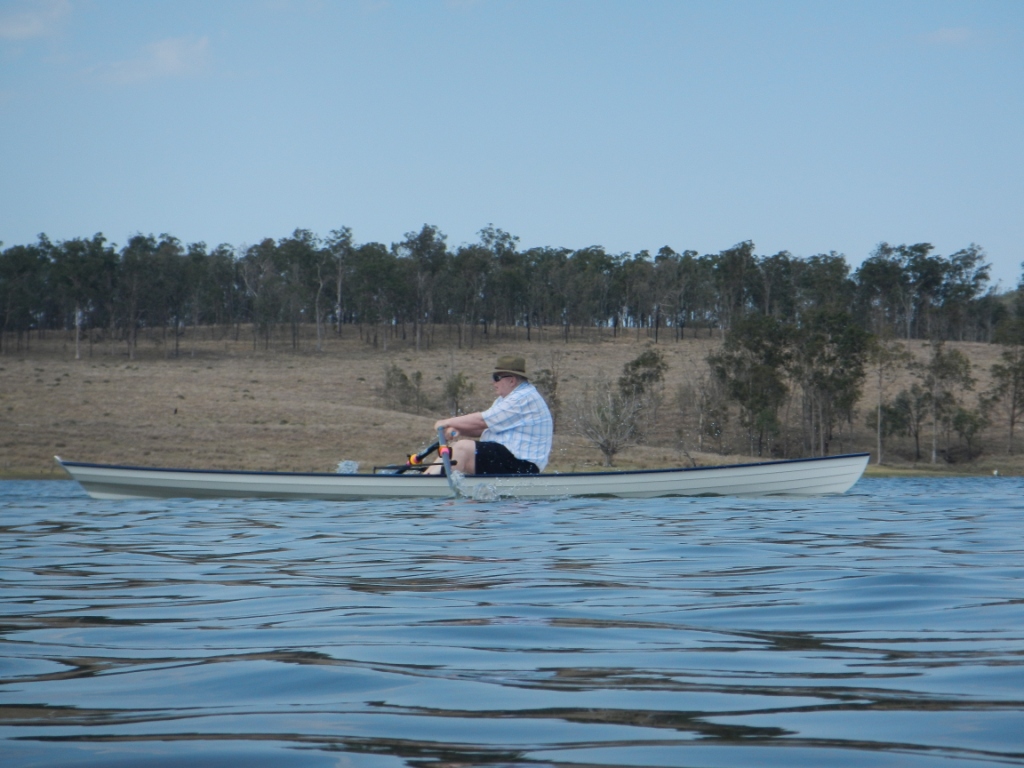
|
| Outboard Profile of Whimbrel, showing her with the original balance lug rig and free-standing mast. Note how the heel of the mast has to swing down and up through the foredack. This arrangement is catered for by the installation of a slot-type box - similar to a centreboard case, but upside-down. |
Tabernacles can be bulky affairs, and I dislike having a tabernacle which extends a long way above the deck line. However, a free-standing mast benefits from substantial "bury" of the mast within an arrangement of mast step and mast partners, or, as in this case, within a tabernacle. My approach was to have the base of the mast swing up and down through a slot in the foredeck, with sides to the box which extend all the way to the level of the mast step. That way, water can drain down the mast, or come on deck as spray, and it simply runs down to the bottom on the mast case and is then drained over the sides through scuppers - making the mast case self-draining.
The design of the slot and case was fairly straight forward, and I was very pleased with how the structural members support each other and go together in a logical fashion. The trouble is that although the mast case (i.e. a structure similar to an upside-down centreboard case) is simple to construct, it was and is very difficult for me to explain on paper. The drawings of all the components are complete in a 2D form, but I do not have the skills to operate the 3D CAD program I have on hand (TurboCAD 17). I do all of my CAD work in an AutoCAD 2D program (AutoSketch 9).
Several times I've tried to do a simple diagram as an "exploded" isometric drawing, but nothing satisfying has eventuated. I thought that the simplest thing would be to build a prototype, and photograph the case construction in detail, as I was/am sure that as soon as people see it, they will appreciate the simplicity and structural elegance.
In the meantime, one of my sons has been experimenting with a tiny jib (set flying) on a small clinker/lapstrake dinghy he built years ago. The small jib has boosted the windward performance of the boat enormously, even though the sail area of the jib is only 11sq. ft (from memory). This boat sailed quite badly with the free-standing rig as originally built, using a carbon windsurfer mast. The mast was just too soft, even with the addition of substantial alloy sleeve at the lower end.

 |
| Here you can see Dave's boat sailing with the original free-standing mast. She had initially sailed with the sail made according to the sail-plan on the plans, but that sail had been awful. Perhaps it would have been ok on a stiffer mast instead of the windsurfer stick. We then changed to an old Laser sail as shown in the pictures, but the mast was still far too soft, and the boat was a very poor performer to windward. |
I've told this story before on the blog, but I suggested to Dave that we put some stays on the rig, with the point of attachment (hounds) being just a fraction over halfway up from the deck to the masthead. He was reluctant, but I eventually convinced him to give it a go and we made up a forestay and two shrouds using Dyneema/Spectra. This also allowed us to set an old jib, as a "flying jib" i.e. a jib with is not attached to the forestay with hanks.

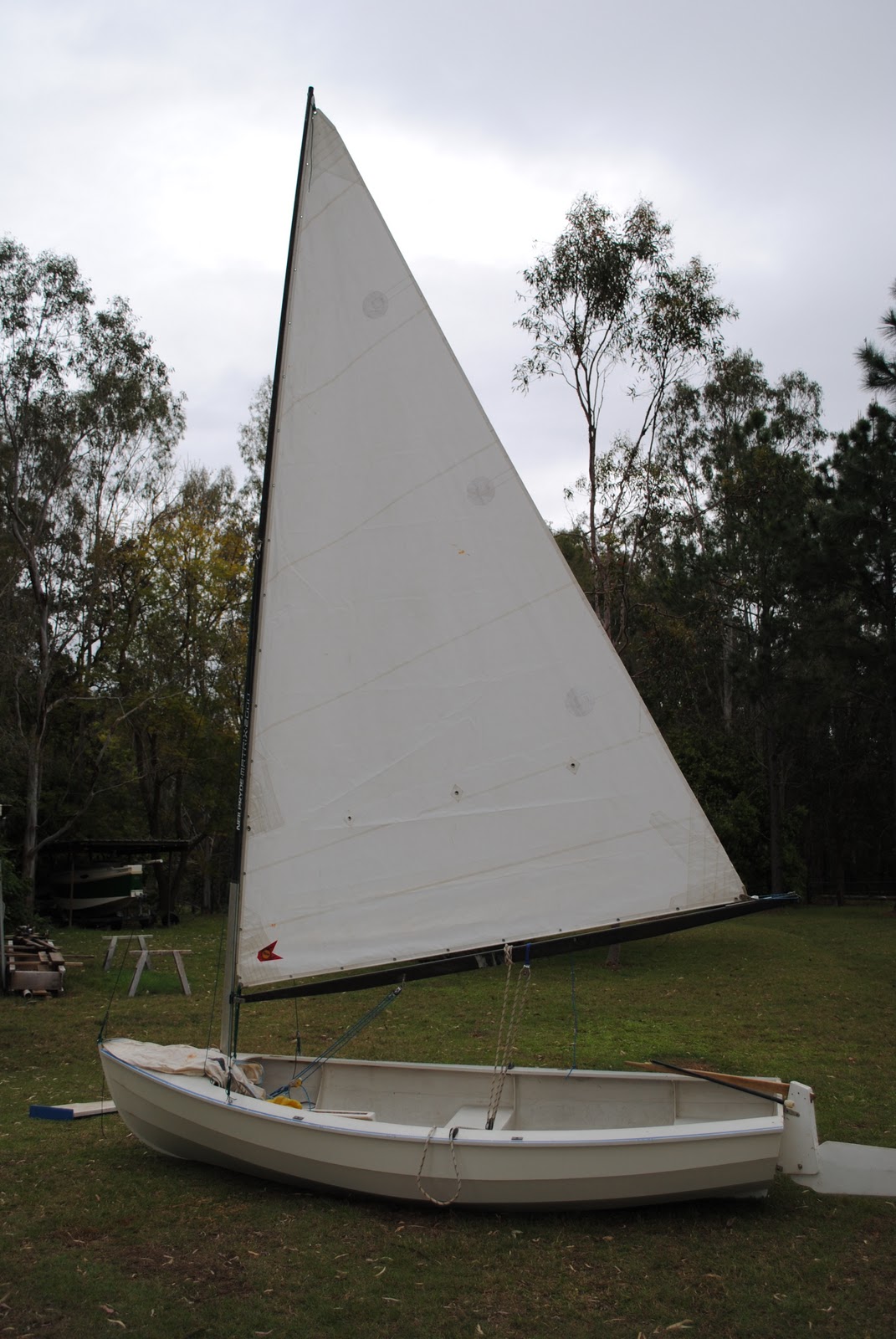

The performance of the boat was dramatically transformed for the better, and the boat is giving great service.
My point in re-telling parts of the rig story is to illustrate that sometimes a very modest increase in complication can result in huge gains in performance. Now, back to Whimbrel....
The revelations about performance brought about by the addition of the jib to Dave's boat got me thinking a little outside the box I normally occupy. I tend to be a bit obsessive when it come to rig simplicity, because I hate clutter in a boat when rigging and un-rigging at the boat ramp. Our experiments with the dinghy rig above have brought me to the point where I'm considering some different rigging arrangements for Whimbrel, and the design evolution continues - perhaps it was fortunate that I hung off from completing the original drawings.

Because the mainmast is now supported by stays in the form of a forestay and two shrouds, the mast no longer requires the support of a tabernacle which runs deeply into the hull. In this case the tabernacle is short and extends only to the level of the deck, and the foredeck is no longer cut up by a mast case and slot. So the mast is significantly shorter at the foot, and the diameter of the mast is reduced from 92mm (3-5/8") to 65mm (2-9/16").
 |
| Whimbrel set up for the night with a boom tent rigged and the mizzen sheeted flat to hold he head -to-wind. I can't see the anchor rode - it must be some of that invisible rope I sometimes use! |
I'm continuing to consider some options for the cockpit, and will up-date soon.


+-+Copy.JPG)